![Flâneurdec[k]](https://substackcdn.com/image/fetch/$s_!o0qh!,w_120,h_120,c_fill,f_webp,q_auto:good,fl_progressive:steep/https%3A%2F%2Fbucketeer-e05bbc84-baa3-437e-9518-adb32be77984.s3.amazonaws.com%2Fpublic%2Fimages%2Fc26e4546-6d4f-4390-a826-f78f7b340047_500x500.png)

Introduction
AI tools like ChatGPT and Claude have quickly become part of everyday work. Teams use them to brainstorm ideas, summarize documents, and think through problems faster.
But when the questions turn to business performance, things start to break down.
Ask AI something like “Why did revenue dip last week?” or “Which channel is underperforming?” and you usually end up doing extra work first:
exporting dashboards,
uploading CSVs,
or manually explaining context.
Even then, the answer often feels incomplete or hard to trust.
The problem isn’t AI itself. It’s the data AI has access to.
Connecting AI directly to your source of truth enables it to work with real, verified performance data instead of static exports.
That’s exactly what Databox MCP (Model Context Protocol) does — it connects Databox performance data to Claude, n8n, Cursor, and any MCP-compatible AI tools, removing manual prep and grounding responses in real metrics.
Why AI struggles with performance questions
Even when AI tools generate coherent answers, they lack structural awareness of how your business data is organized.
They don’t automatically understand:
How specific metrics are calculated
Which definitions your team relies on
How performance connects across departments
What historical patterns or seasonality look like
Without direct access to that context, AI responses remain surface-level. They may summarize what you provide, but they can’t independently investigate trends, validate assumptions, or reconcile data across sources.
As a result, teams either accept incomplete answers or spend additional time preparing data before asking the question in the first place — reducing the efficiency AI is meant to provide.
That’s where Databox MCP changes the equation.
What is Databox MCP?
Databox MCP is a server that connects your Databox account to AI tools and AI agents.
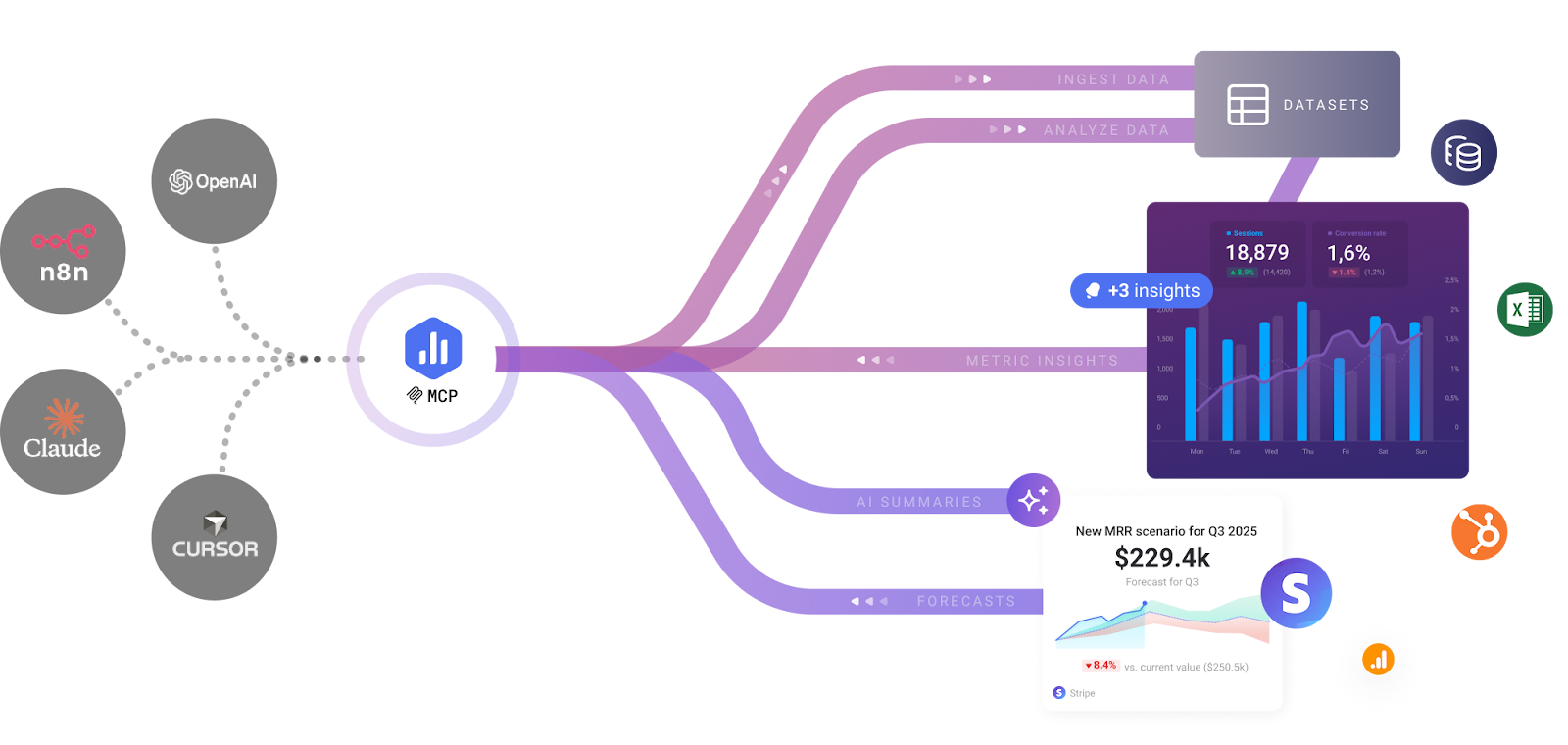
It allows compatible AI tools to:
Query real Databox metrics and datasets
Access historical performance trends
Use verified metric definitions
Respect goals and forecasting context
Trigger workflows or actions based on insights
In simple terms:
Databox MCP gives AI access to your source of truth.
Instead of copying data into AI, AI connects directly to Databox.
👉 This is how easy it is to connect Databox MCP to AI tools
How Databox MCP Works
Databox MCP acts as a server that connects your Databox account to AI tools such as ChatGPT, Claude, n8n, Cursor and other MCP-compatible clients.
Once connected:
You ask a performance question.
The AI queries live Databox data.
It analyzes metrics, trends, and goals.
It returns contextual answers grounded in real numbers.
No CSV exports, no manual prep, and no spreadsheet cleanup.
What you can do with Databox MCP
1. Ask performance questions in plain language
Instead of navigating dashboards, you can ask:
“Why did organic traffic drop last week?”
“Which campaigns are driving the pipeline?”
“How are we pacing against our revenue forecast?”
Because the AI is connected to Databox, answers reflect actual performance data, not generic assumptions.
2. Analyze data across multiple tools
Databox integrates 130+ data sources. With MCP, AI can evaluate performance across Google Analytics 4, Google Search Console, HubSpot, Stripe, advertising platforms, custom datasets and many more.
All within one conversation.
3. Generate recurring executive summaries
Use MCP with automation platforms like n8n to:
Create weekly KPI summaries
Send Slack updates when goals are missed
Automatically generate performance narratives
This moves AI beyond analysis and into structured reporting.
4. Trigger automated workflows
Because AI remains connected to your systems, insights can trigger actions:
Notify stakeholders when revenue drops
Flag anomalies in marketing spend
Schedule follow-up analyses
This bridges the gap between insight and execution.
5. Ingest and structure new datasets
You can also use AI to clean and standardize exported CSV files, pull data from APIs and push structured datasets into Databox
That makes Databox MCP not only an analysis layer, but also a flexible data ingestion tool.
Want to see Claude query live Databox data and answer real performance questions?
👉 See it in action:
Who benefits most from connecting AI to real performance data
Databox MCP can be especially helpful for:
Agencies and consultants
Answer client questions faster without rebuilding reports or digging through dashboards. Instead of exporting data or manually preparing context, they can use AI to analyze trusted metrics instantly.Founders and executives
Leaders can pressure-test revenue, growth, and pipeline trends without waiting on reports or analyst support.Functional leaders
AI-powered performance analysis makes it easier to spot issues, identify trends, and act quickly.
If reporting, dashboards, or KPI tracking are part of their daily workflow, connecting AI to your source of truth removes unnecessary friction and speeds up decision-making.
Getting started with Databox MCP
Databox MCP works with tools like ChatGPT, Claude, n8n, and Cursor, and it’s included with all Databox plans.
If you already use Databox and AI tools, you can start exploring MCP right away.
If you’re new to Databox, or want to understand how MCP fits into the broader platform, it’s worth starting with a quick Databox demo to see how everything works together.
👉 Learn more about Databox MCP or request a Databox demo here: https://join.databox.com/p0lvcbbe6ijc.1
Time to start your AI-powered performance analysis
AI is most useful when it works with data you actually trust.
Connecting AI directly to your performance data is a small shift that can make everyday questions faster to answer and easier to act on.
Linking with Context
A. BARC Data, BI and Analytics Trend Monitor 2026 < https://barc.com/news/barc-publishes-the-data-bi-and-analytics-trend-monitor-2026/ >.
B. AI and Data Strategy in 2026: What Leaders Need to Get Right < https://www.analytics8.com/blog/ai-and-data-strategy-in-2026-what-leaders-need-to-get-right/ >.
C. Is Your Annual Plan Just Math, or a Real Strategy? < https://databox.com/research-reports/the-state-of-annual-planning-and-modeling/ >.
D. Why 84% of Technical Leaders Need a Data Overhaul for 2026 AI Strategies < https://www.salesforce.com/news/stories/data-analytics-trends-2026/ >.
I believe in transparency. So, heads up: some links in this review are affiliate links. If you purchase them, I may earn a small commission (at no extra cost to you!). It helps me keep the lights on and create more helpful content like this.